
GEO: What is Generative Engine Optimisation?
 admin
admin
The rise of AI is forcing businesses to rethink their natural search strategies. Traditional practices, such as keyword research and manual writing, are evolving to integrate AI-based tools, including predictive analysis and intelligent crawling. Content optimisation now requires greater attention to semantic relevance and conversational queries. Businesses must also adopt web design principles that meet the demands of AI systems, such as schema markup and clear content organisation.
The bigger picture: the fragmentation of online search
For millions of consumers worldwide, Google has long been the main gateway to the Internet. It has dominated the search market for more than 25 years, holding around 91% market share. But in January 2025, its share dipped below 90% for the first time. And with the rise of AI-driven search engines (such as SearchGPT, Perplexity, AI Overviews, and Copilot) alongside new habits on platforms like Amazon and TikTok, the search landscape is splintering.
A new generation of technologies has emerged, driven by advances in large language models (LLMs). These models can fuse traditional search with conversational AI to create so-called Generative Engines. Instead of simply listing links, they gather information from across the web and produce natural language answers, citing multiple sources so users can check the facts. It marks a genuine revolution in how knowledge is discovered and consumed online.
A new buzzword is also making waves in the tech world, appearing under several names: Large Language Model Optimisation (LLMO), Generative Engine Optimisation (GEO), or Generative AI Optimisation (GAIO).
As people increasingly turn to these tools to research products and services, SEO professionals must ensure their brands are included among the “sources” used by AI engines. According to Harvard Business Review, SEO specialists will soon be known as LLMO experts – Large Language Model Optimisation specialists.
What is Generative Engine Optimisation (GEO)?
Generative Engine Optimisation (sometimes called Search Artificial Intelligence Optimisation (SAIO)) refers to optimisation for AI-driven search engines. GEO has emerged as a response to these new search systems, which no longer just rank web pages but generate full answers by synthesising information from multiple sources.
In the same way that SEO helps a website rank in traditional search engines, SAIO focuses on optimising a site so that it can be surfaced by conversational chatbots and voice assistants.
For example, when a user today asks Google SGE or Perplexity “how to treat a mosquito bite naturally”, these tools no longer simply return a list of links. Instead, they generate a complete answer, pulling together insights from a range of sources.


What’s the difference between GEO and SEO?
Unlike traditional SEO, which focuses on ranking within a list of search results, GEO is about getting your content directly included in the AI-generated answers themselves.
The big question many are asking about GEO is whether AI-driven search engines apply the same criteria as classic SEO when choosing which content to feature in their responses. The answer is mixed: yes and no. While there are some overlaps, the two approaches are built on fundamentally different logics.
Traditional SEO relies on technical factors, such as crawlability, crawl budget, and page structure, alongside semantic and authority signals to improve a site’s position in search results. The goal is clear: optimise pages to meet algorithmic requirements and gain visibility in the search engine results pages (SERPs).
By contrast, GEO emphasises the intrinsic quality of content. AI-powered search engines give particular weight to how precisely and effectively content answers user intent. Thanks to natural language processing, these engines can understand the context of a query and prioritise high-value content: informative, well-structured, readable, and relevant. As a result, GEO pays less attention to the traditional technical aspects of SEO and instead focuses on depth, clarity, and contextual relevance.
How do GenAI search engines work?
At their core, they are transformer-based neural networks. These foundation models use generative AI (deep learning, more specifically) for natural language processing (NLP) and natural language generation (NLG). Trained on vast datasets, they have developed a sophisticated understanding of language. The goal of LLMs is to learn the complexity of human communication, and they are pre-trained on huge amounts of data, such as text, images, speech, structured data, and more. According to Grand View Research, the global LLM market is expected to grow by 36% between 2024 and 2030.
A key element in LLM search is known as retrieval-augmented generation (RAG). This allows an LLM to draw on additional context (such as corporate sets or web content) to enhance its base model when responding to queries. This has major implications for anyone working in LLM optimisation: if you want to influence the text an LLM produces in response to a query, you need to think strategically about how to shape the different sources it is most likely to draw from.
SearchGPT
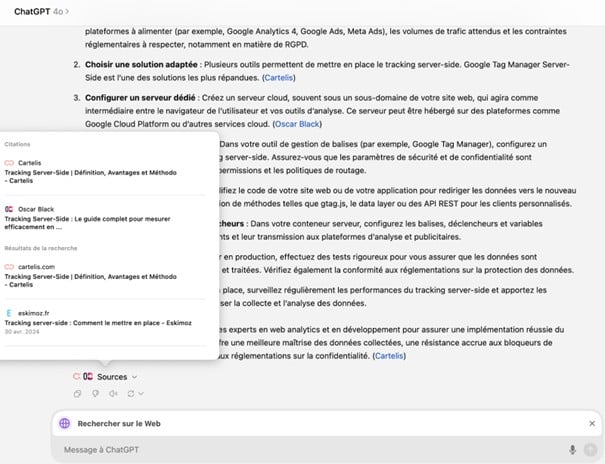
ChatGPT Search is a search engine developed by OpenAI and integrated into ChatGPT. It combines the functions of traditional search engines with generative AI, producing sourced answers that include links to relevant websites.
Perplexity
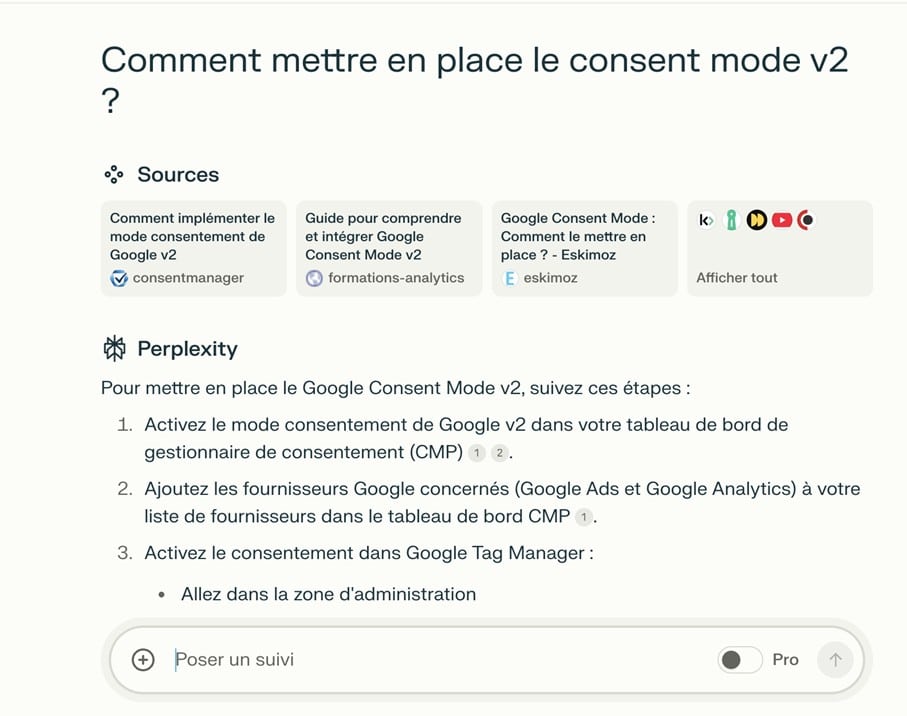
Perplexity is a search engine similar to Google or Bing. It’s freely accessible at perplexity.ai and supports multiple languages, including French and English. Users can either search with keywords or ask longer, natural language questions. In both cases, the engine rewrites the query and runs multiple searches to deliver precise answers (sometimes to several related questions at once). You can also upload attachments, such as images or documents, and ask it to extract information from those sources.
AI Overviews (Google)
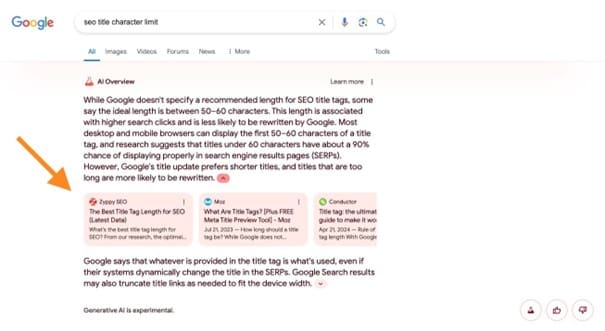
Google’s AI Overviews (or “AI summaries”) appear in search results when the system determines that generative answers could be particularly useful, for instance, when you want to quickly understand information drawn from multiple sources. These summaries include links to supporting resources, allowing users to explore the topic in more depth.
Copilot (Bing)
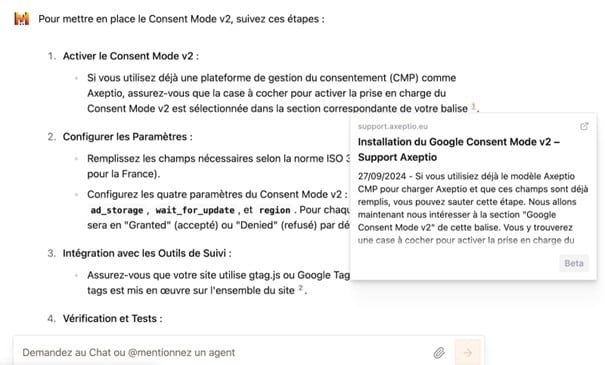
Microsoft Copilot is an everyday AI assistant that provides conversational AI for the web. It gives access to AI powered by large multimodal language models and text-to-image systems, including GPT-4o. Copilot is built into Bing’s search service to deliver up-to-date answers from across the web, complete with verifiable citations for transparency.

“Le Chat” (Mistral)
On 26th February 2024, Mistral, a French company specialising in generative AI, launched Le Chat, a conversational bot similar to ChatGPT that allows users to try out its models. At the same time, the company unveiled Mistral Large, a new language model designed to rival GPT-4, alongside Mistral Small, a lighter version, and Mistral Next, a prototype built to deliver short, concise answers.
It’s important to understand how and why LLMs produce the answers they do. With that knowledge, SEO professionals can make smarter decisions about where to invest – whether in SMO, content marketing, or public relations.
How can I optimise my site for GEO?
AI-powered search engines such as SearchGPT, Perplexity, or Google’s SGE are redefining the rules of search, blending traditional SEO criteria with the unique features of language models. To stand out in these new environments, it’s essential to adopt a holistic strategy that combines high-quality content, online authority, thematic relevance, and technical excellence.
Identifying the sources used by AI engines
The first step is to understand the sources LLMs draw on when generating answers. When asked directly, here’s what the engines themselves say. On OpenAI’s website, for example, we read: “We’ve also partnered with news and data providers to add up-to-date information and new visual formats for categories such as weather, stocks, sports, news, and maps.” And when you question generative AI search engines directly (ChatGPT, Perplexity, Copilot, etc.), the sources they most often rely on include:
- Official and institutional sites
- Search engines (e.g., Google, Bing)
- Specialist publications and media outlets
- Databases and encyclopaedic resources
- Mainstream media
- News agencies
- Community platforms (e.g., Wikipedia)
- Forums and social networks (e.g., Reddit, LinkedIn, X)
Relevance and depth of content
AI search engines prioritise content that directly aligns with user queries. A study by Neil Patel shows that both brand mentions across the web and the use of relevant keywords within content increase the likelihood of being recommended by SearchGPT. For example, a tech company that is regularly cited in articles, forums, and customer reviews will have greater visibility.
Adding depth to content with precise statistics, expert quotes, and academic sources also strengthens credibility. A group of AI researchers conducted a study of 10,000 real search queries on Bing and Google to identify the techniques most likely to improve visibility in RAG-based chatbots, such as Perplexity. For each query, they randomly selected a website to optimise and tested different types of content (e.g., citations, technical terms, statistics) and characteristics (e.g., fluency, readability, authoritative tone). From this, they developed several GEO optimisation methods:
- Inserting relevant keywords (as in traditional SEO)
- Adding statistics and quantitative data
- Citing sources
- Simplifying language (making content more accessible)
- Using a persuasive style
- Improving structure and readability
- Enriching content with technical terms
Statistics, sources, and citations strengthen a brand’s authority and credibility. They also tend to attract backlinks. The study showed that including statistics increased visibility by 40% for complex queries, reinforcing perceptions of authority among both users and algorithms. For example, an online education platform citing figures on the impact of certified training courses is more likely to be referenced by Perplexity or Google’s AI Overviews.
We also know that AI search engines prioritise up-to-date information. Keeping content current is therefore crucial. Engines such as SGE reward sites that provide fresh, relevant data, particularly in fast-moving sectors like healthcare and finance. A Semrush study revealed that older content was less likely to be included in generated answers. For instance, an investment advisory site must regularly refresh its articles with the latest market trends to maintain visibility.
Search is becoming conversational
As journalist and author Cory Doctorow once observed: “Content isn’t king; Conversation is queen. Content is just something to talk about.” So, is the future of search conversational? Conversational search refers to an interaction between a user and a search engine or virtual assistant carried out in natural language. Unlike traditional search, which depends on keywords, it relies on artificial intelligence and natural language processing (NLP) to understand the intent behind queries and deliver fluid, contextual, and dynamic answers. Tools such as Google’s Search Generative Experience, ChatGPT, and Perplexity already offer a more intuitive and interactive search journey, where users can refine their queries in real time through a genuine conversation.
According to market research from Allied, the conversational AI sector is expected to reach $32.6 billion by 2030. This trend reflects the growing appetite for such technology, especially in the modern business world, where customer service is more important than ever. Conversational AI provides round-the-clock interaction across multiple domains and channels – vital in a global economy that never sleeps.
For brands, writing in a conversational style means speaking the same language as AI. Long, complex sentences and overly formal phrasing should be avoided. To rank in PErplexity or SearchGPT, a fluid, engaging tone that answers the questions audiences are actually asking will make the difference. Perplexity, for example, suggests “Related Questions” much like Google’s People Also Ask. To anticipate these and increase the chances of being surfaced, SEO professionals should identify likely follow-up questions and build them into their content. AI models prioritise clarity and readability: short sentences work best, while bullet points and lists help engines like Perplexity extract key points more easily.
Authority and online reputation
AI search engines draw on the concept of E-E-A-T (Expertise, Experience, Authoritativeness, Trustworthiness) to assess the reliability of sourses, just as traditional search engines do. Building a strong online reputation is therefore essential. Positive customer reviews on platforms such as Trustpilot or Google Reviews help boost credibility – a crucial factor in appearing in AI search recommendations. Another key requirement is developing a strong brand identity. As AI-generated content becomes increasingly uniform, brand differentiation matters more than ever. In fact, according to research from Ahrefs, 50% of Google queries already contain branded keywords.
“The truth is this: when value is equal, reputation is what makes the difference.” – Jérémy Lacoste, Managing Director, Eskimoz France
Managing online reputation is a vital part of this strategy. A brand that is active on social media and forums such as Reddit or X sends multiple positive signals that AI search engines can pick up, increasing the chances of being cited. Brands with an active Wikipedia page also enjoy a clear advantage. As Selena Deckelmann, Director at the Wikimedia Foundation, explains: “As of today, every LLM is trained on Wikipedia content, and it is almost always the largest training dataset they use.”
The role of media relations
Media relations also play a key role in this strategy. Being mentioned in respected publications or rankings such as “Products of the Year” generates positive co-occurrences that boost visibility. For instance, a fintech company cited in the Financial Times is more likely to be recommended by Google’s SGE for searches such as “best banking solutions for startups”. Positive media coverage not only raises awareness with a wide audience but also builds credibility and trust. AI search engines place strong emphasis on information from reputable sources. To be cited by these engines, make sure your content is reference in reliable publications. The convergence of PR and search engine optimisation has become an essential strategy for maximising a company’s visibility and reputation.
A clearly differentiated brand with strong online influence will be more easily recognised by both AI engines and users, further reinforcing its credibility.
Search intent
The real difference between SEO rankings and GEO lies in search intent.
Search intent refers to the goal that motivates a user to type a query into a search engine. It reflects the underlying purpose behind the keywords used and allows algorithms to refine results to best meet user needs. Search intent is generally divided into four categories: informational (looking for knowledge, e.g., “how does AI work?”), transactional (buying a product or service, e.g., “buy Samsung smartphone”), navigational (going to specific site, e.g. “LinkedIn login”), and commercial (comparing options before purchase, e.g., “best SEO software 2024”). Search intent is a critical lever for visibility. A Semrush study found that 80% of the keywords triggering AI answers in Google are informational in nature, often phrased as questions (“how”, “why”, “what is the best solution for…”). Structuring content around these queries – with question-based headings and well-designed FAQ sections on “best family holiday destinations for summer” is more likely to appear in results generated by Perplexity or SearchGPT.
Search engines themselves place a strong emphasis on intent. This means your content must respond directly to the questions people are asking. Start by identifying the main intent behind your users’ searches. Tools like Google Keyword Planner and Ahrefs can help uncover the underlying needs driving specific queries. To be recognised in a given context, your brand should also be repeatedly mentioned alongside key industry terms and phrases. These associations – known as co-occurrences – help language models connect your brand with specific topics.
Technical excellence and accessibility
Traditional SEO technical criteria remain essential for maximising visibility in AI search. Fast loading speeds, optimised images, and mobile compatibility are critical to delivering a smooth user experience, which is valued by algorithms. In addition, correctly configuring your robots.txt file to allow crawling by AI bots such as OAI-Searchbot ensures your content is taken into account. Structured data (schema) is another powerful lever: implementing schema markup helps AI engines better understand and categorise content, increasing the chances of being featured in rich snippets or Knowledge Graph panels. For example, FAQs with appropriate markup are more likely to be surfaced by Perplexity, particularly in its “Related Questions” sections.
Voice search
The rise of AI search is changing how users navigate and what they expect from results. On average, people can speak around 150 words per minutes, but only type about 40 in the same time. The choice is clear: speech is almost four times faster than typing.
It’s no surprise, then, that voice search is becoming an increasingly common user behaviour, especially for transactional or local queries. According to Statista, more than 25% of people in Western countries report using digital voice assistants several times a day. Voice search is powered by speech recognition technology that allows users to search by speaking aloud instead of typing into a search bar. The proliferation of smartphones and other mobile devices has driven interest in this form of search.
Structuring content with conversational and long-tail keywords (e.g., “where can I find a café nearby?”) improves integration into results of conversational AI engines like Perplexity or SearchGPT. Optimising websites for mobile is now non-negotiable: according to Eskimoz’s Search Marketing barometers, 60% of queries are carried out on mobile.
Optimising organic and local SEO
The big question around GEO is whether AI-driven search engines rely on the same criteria as SEO to decide which content to display in their answers. We analysed a wide range of similar queries on Google and Perplexity to see if any correlations emerged. The result: sites that rank in the top 10 of Google’s SERPs are more likely to appear in Perplexity’s answers for the same query.
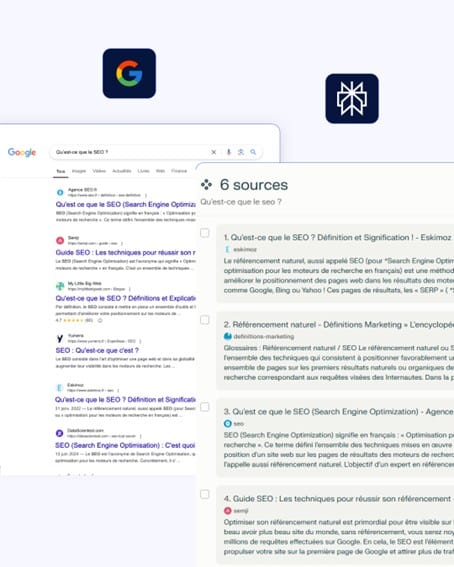
For local searches, it appears that the businesses ranking highest in the Local Pack or on Google Maps are also the ones most frequently featured in Google’s SGE panels. Strengthening local SEO efforts is therefore key to achieving strong placement in Search Generative Experience results for this type of query.
“The rise of AI requires SEO experts to strengthen their strategy across every lever. Average results will no longer be enough in this new environment, where only the best will capture the majority of traffic. It is therefore essential to invest heavily in SEO, with a particular focus on three pillars: popularity, technical performance and content.” – Andréa Bensaïd, Founder of Eskimoz.
GEO: Why optimise for AI search engines?
AI search engines such as ChatGPT or Bard are redefining the way users seek information, opening up new opportunities for brands. By appearing in the answers generated by these tools, businesses can secure visibility in a rapidly evolving digital ecosystem. These engines provide an innovative way to strengthen brand awareness while positioning companies as pioneers in an emerging field – a competitive advantage often described through the “first-mover effect.”
Investing in optimisation for these platforms also allows brands to establish themselves as leaders by occupying more space in results, leaving less room for competitors. AI search engines bring a conversational, personalised dimension, enabling brands to engage meaningfully with consumers who often show strong purchase intent. In this context, a product or service recommendation can have a direct impact on conversion.
Finally, optimising content for AI search engines creates a unique opportunity to build lasting relationships with potential customers. By aligning AI-generated answers with real user intent, businesses can embed themselves into buying journeys and nurture long-term loyalty. Optimisation for AI search isn’t just about visibility – it’s about actively participating in the conversations that shape consumer decisions.

Need to talk with an expert?
